

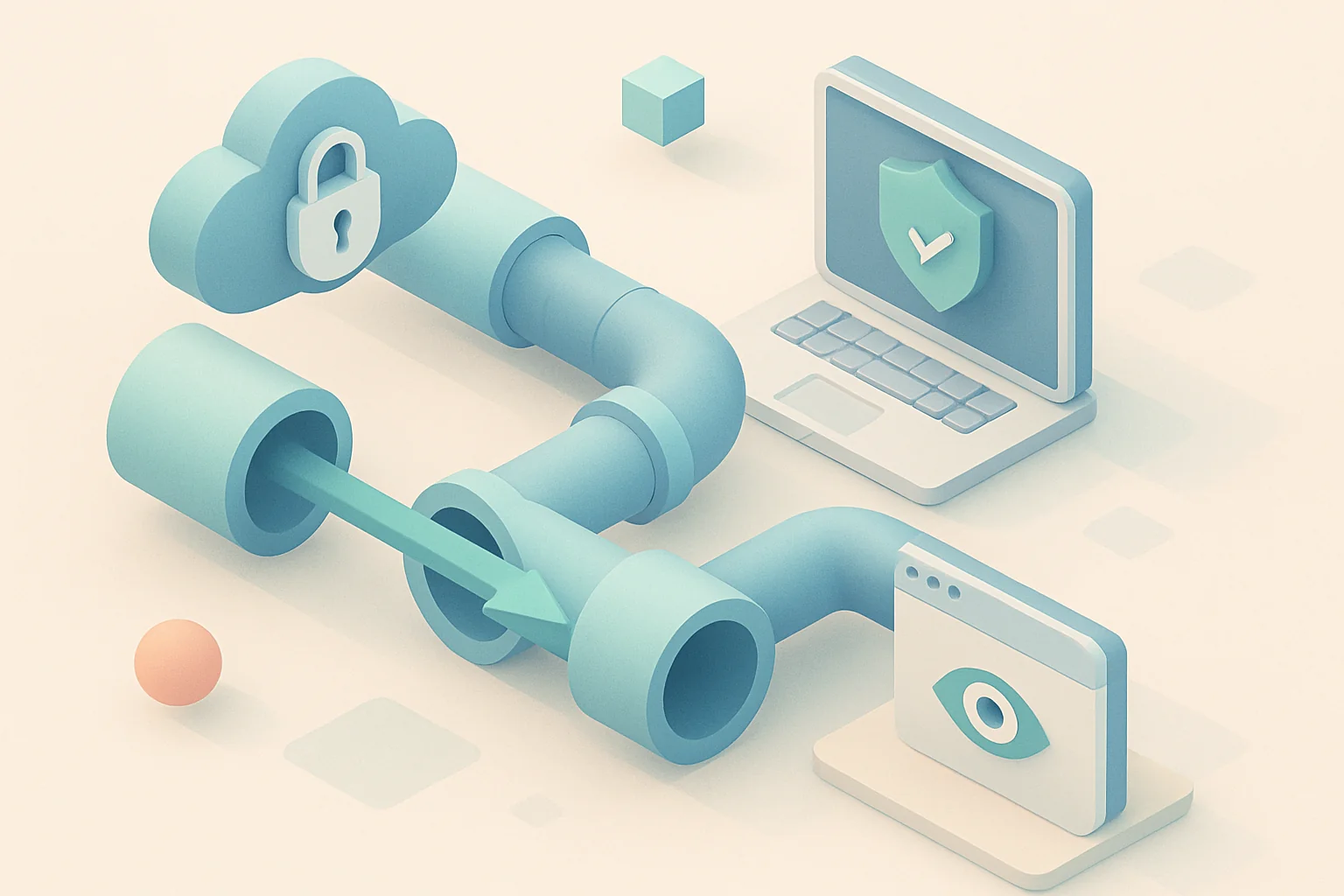
Every time you browse the web without a VPN, your internet service provider logs every website you visit, advertisers track your location, and anyone sharing your public WiFi network can intercept your passwords. VPN encryption transforms this vulnerable data stream into an unreadable tunnel that shields your activity from ISPs, hackers, and surveillance. But what actually happens when your VPN client “encrypts” your connection? This guide demystifies the cryptographic protocols, cipher suites, and handshake processes that create truly secure tunnels—explaining the technical reality behind VPN encryption in accessible language that helps you make informed decisions about your online privacy.
What Is VPN Encryption and Why Does It Matter?
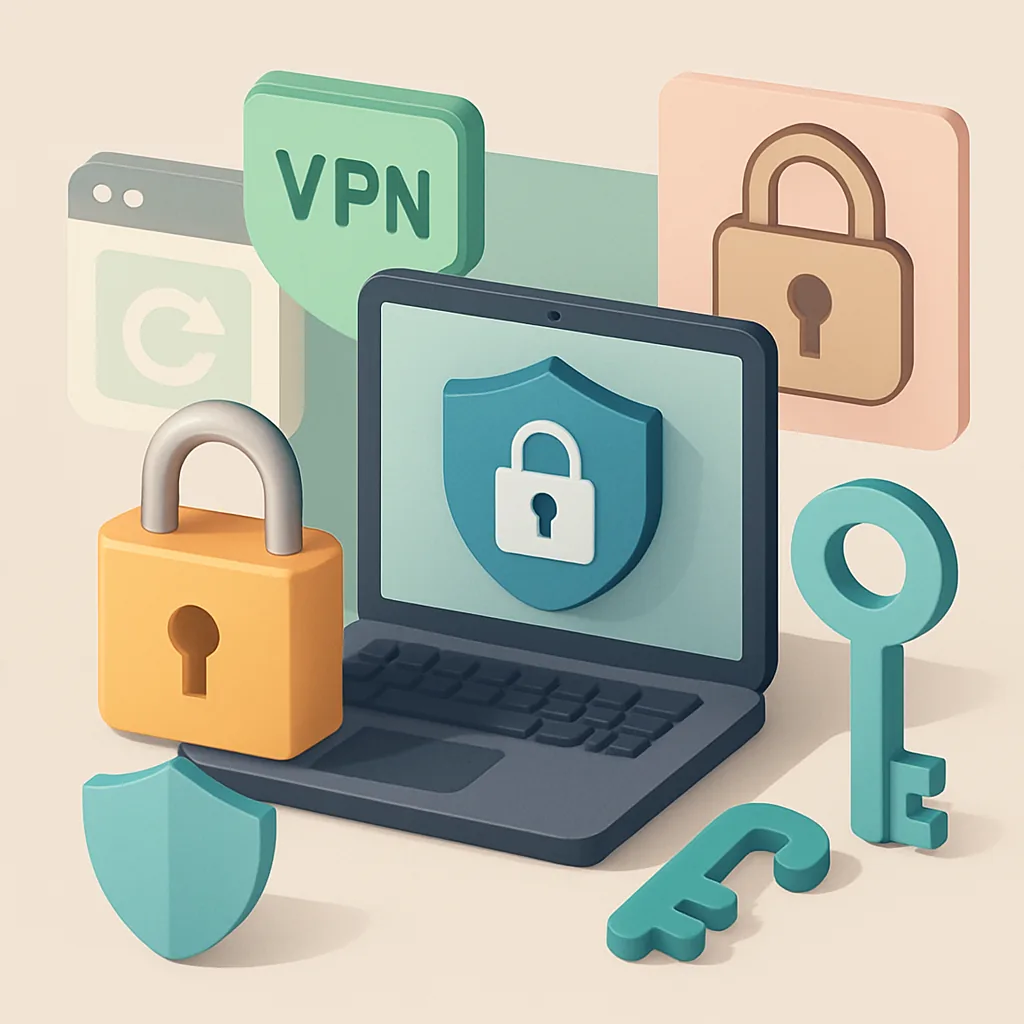
When you connect to a VPN, your device creates an encrypted tunnel that wraps every data packet in multiple layers of cryptographic protection before sending it across the internet. This encryption transforms readable information—your browsing history, login credentials, messages, and file transfers—into scrambled ciphertext that remains unreadable to anyone intercepting it between your device and the VPN server.
The encryption process works both ways. Outgoing traffic gets encrypted on your device before leaving through your internet connection, while incoming data arrives encrypted and gets decrypted only after reaching your device. Your internet service provider sees only encrypted noise flowing to a VPN server’s IP address, with no visibility into which websites you visit or what data you transmit. The same protection shields you from hackers on compromised public WiFi networks and network administrators monitoring traffic on shared connections.
The Secure Tunnel Concept
Think of VPN encryption as a sealed, opaque tube running through a glass pipe. The glass pipe represents your regular internet connection—transparent to your ISP, network operators, and potential attackers. The sealed tube inside is your encrypted VPN tunnel. Observers can see that data flows through the tube and measure its volume and timing, but they cannot read the contents without breaking the encryption.
Modern VPNs typically use AES-256 encryption, the same standard protecting classified U.S. government communications. This symmetric cipher would require approximately 27 quintillion years to crack through brute force using current computing technology, making it practically unbreakable for the foreseeable future.
Real-World Threats VPN Encryption Prevents
VPN encryption directly counters several common attack vectors. Man-in-the-middle attacks, where an attacker positions themselves between your device and destination to intercept traffic, become ineffective because the attacker receives only encrypted data. Packet sniffing tools that capture network traffic on public WiFi hotspots similarly collect worthless ciphertext. Deep packet inspection—used by ISPs and governments to analyze traffic content—sees only the encrypted tunnel, not the websites or services inside.
However, encryption alone doesn’t equal complete privacy or anonymity. While encryption scrambles your data content, it doesn’t inherently hide your identity from the VPN provider, mask all metadata patterns, or prevent browser fingerprinting. Encryption protects data confidentiality during transmission, but true privacy requires additional measures like no-logs policies, and genuine anonymity demands tools like Tor that VPNs cannot provide by themselves.
AES-256: The Gold Standard of VPN Encryption
The U.S. government trusts AES-256 encryption to protect its classified information, and premium VPN providers use the exact same standard to secure your internet traffic. This symmetric encryption algorithm employs 256-bit keys, which translates to 2^256 possible combinations—a number so astronomically large that even dedicated supercomputers would need approximately 27 quintillion years to crack a single key through brute force attacks.
Understanding Symmetric Encryption
AES-256 belongs to the symmetric encryption family, where the same key both encrypts and decrypts data. This approach delivers exceptional speed compared to asymmetric encryption, making it ideal for protecting the constant stream of data flowing through a VPN tunnel. Once your VPN client and server complete their initial handshake using asymmetric cryptography, they switch to AES-256 for all subsequent data transmission.
The “256-bit” designation refers to the key length—specifically, 256 binary digits that create 1.1 x 10^77 possible key combinations. To put this in perspective, there are roughly 10^80 atoms in the observable universe. No current or foreseeable computing technology, including theoretical quantum computers, poses a practical threat to properly implemented AES-256 encryption.
AES vs. ChaCha20: Performance Trade-offs
While AES-256 remains the industry standard, modern VPN protocols increasingly offer ChaCha20-Poly1305 as an alternative cipher. ChaCha20 particularly excels on mobile devices and older processors lacking dedicated AES hardware acceleration. Smartphones and tablets running ChaCha20 often achieve 30-50% better battery efficiency and faster connection speeds compared to software-based AES implementations.
Both ciphers provide equivalent security when properly configured. The choice between them typically depends on your device’s hardware capabilities rather than cryptographic strength. Most contemporary VPN clients automatically select the optimal cipher for your specific hardware, ensuring maximum performance without sacrificing protection.
VPN Protocols: Different Approaches to Secure Tunneling
Modern VPN services rely on tunneling protocols that determine how your data travels from your device to the VPN server. Each protocol makes different engineering trade-offs between speed, security, code complexity, and device compatibility. Understanding these differences helps you choose the right protocol for your specific privacy needs and network conditions.
| Protocol | Code Size | Typical Speed | Best Use Case | Key Advantage |
|---|---|---|---|---|
| OpenVPN | ~70,000 lines | 400-600 Mbps | General purpose, high security | Extensively audited, highly configurable |
| WireGuard | ~4,000 lines | Up to 1,000 Mbps | Speed-critical applications | Minimal attack surface, modern cryptography |
| IKEv2/IPSec | Varies | 600-800 Mbps | Mobile devices, unstable networks | Fast reconnection, network switching |
| L2TP/IPSec | Varies | 200-400 Mbps | Legacy system compatibility | Wide device support |
OpenVPN: The Reliable Workhorse
OpenVPN has dominated the VPN landscape for over two decades through extensive security audits and proven reliability. Its 70,000+ lines of code provide exceptional configurability, allowing VPN providers to customize encryption ciphers, authentication methods, and obfuscation techniques. This flexibility comes with complexity—more code means a larger attack surface, though the open-source nature ensures continuous scrutiny from security researchers worldwide. OpenVPN operates over both TCP and UDP, making it adaptable to restrictive networks that block standard VPN ports. While speeds typically plateau around 400-600 Mbps, the protocol’s maturity and widespread compatibility make it the default choice for privacy-focused users who prioritize security over raw performance.
WireGuard: The Modern Speed Champion
WireGuard represents a fundamental rethinking of VPN protocol design. With only 4,000 lines of code—roughly 5% of OpenVPN’s codebase—it dramatically reduces the potential for implementation vulnerabilities. This minimalist approach delivers speeds approaching 1,000 Mbps while maintaining strong cryptographic standards. The protocol uses state-of-the-art encryption primitives including ChaCha20 for symmetric encryption and Curve25519 for key exchange. However, WireGuard’s lean design initially presented privacy challenges: the protocol stores IP addresses on servers by design, requiring VPN providers to implement additional privacy layers. Despite this consideration, major VPN services have successfully integrated WireGuard variants that preserve user anonymity while delivering exceptional performance.
IKEv2/IPSec: Mobile-Optimized Security
IKEv2 excels in scenarios where network conditions constantly change. The protocol’s MOBIKE (Mobility and Multihoming) extension allows seamless transitions between Wi-Fi and cellular data without dropping your VPN connection—a critical feature for smartphone users moving between networks. Reconnection happens within seconds rather than the 30-60 seconds typical with OpenVPN. Native support across iOS, macOS, and Windows eliminates the need for third-party applications, though Android implementation requires additional software. Speeds typically reach 600-800 Mbps with lower battery consumption compared to OpenVPN, making IKEv2/IPSec the protocol of choice for mobile-first VPN implementations.
The VPN Handshake: How Encryption Keys Are Established
When your VPN client first connects to a server, it faces a fundamental challenge: how do two parties establish a secure connection over an inherently insecure internet connection? The answer lies in the VPN handshake, a sophisticated cryptographic dance that occurs in milliseconds every time you connect.
Asymmetric vs. Symmetric Encryption
The handshake employs a two-phase encryption strategy because no single encryption method efficiently balances both security and performance. Initially, the connection uses asymmetric encryption algorithms like RSA or Elliptic Curve Cryptography (ECC) to establish trust and exchange encryption keys. RSA-2048, one of the most common implementations, provides security roughly equivalent to 112-bit symmetric encryption. These algorithms use a public-private key pair where data encrypted with one key can only be decrypted with its counterpart.
However, asymmetric encryption is computationally expensive. Processing each data packet with RSA would create unacceptable latency and drain battery life on mobile devices. That’s why, once the initial handshake completes and both parties have securely agreed upon a shared secret key, the connection switches to symmetric encryption—typically AES-256. Symmetric encryption uses the same key for both encryption and decryption, making it dramatically faster while maintaining robust security for the actual data transmission.
Understanding Cipher Suites
Modern VPNs don’t use these algorithms in isolation. Instead, they employ cipher suites—bundled combinations of cryptographic algorithms that work together throughout the connection lifecycle. A typical cipher suite specifies four distinct components: the key exchange algorithm (RSA-2048 or ECDHE), the authentication method (verifying server identity), the bulk encryption algorithm (AES-256-GCM for data), and the message authentication code (SHA-256 for data integrity).
When your VPN client initiates a handshake, it sends a list of supported cipher suites ranked by preference. The server responds with its chosen suite from the compatible options, and this selection determines the security characteristics of your entire session. Premium VPN providers prioritize cipher suites that include Perfect Forward Secrecy (PFS), which generates unique session keys that can’t decrypt past traffic even if the server’s private key is later compromised.
Perfect Forward Secrecy: Protecting Past and Future Sessions
When a VPN session key gets compromised, Perfect Forward Secrecy (PFS) ensures that attackers can’t decrypt your past internet activity or future sessions. This critical security feature generates unique, temporary encryption keys for each VPN session using ephemeral Diffie-Hellman key exchange, creating a cryptographic barrier between different periods of your online activity.
Without PFS, VPN providers rely on a single master key to derive session keys. If an adversary compromises that master key—through a server breach, legal compulsion, or cryptographic vulnerability—they can retroactively decrypt all recorded traffic. With PFS enabled, each session uses keys that exist only in volatile memory and are destroyed immediately after the session ends. Even if your VPN provider’s long-term private key is later exposed, previously captured encrypted traffic remains unreadable.
The mechanism works through ephemeral key exchange. When you connect to a VPN server, both endpoints generate temporary private keys that are never transmitted across the network. Through Diffie-Hellman mathematics, they derive a shared session key without ever exposing it to interception. Once your session ends, both sides discard these ephemeral keys, making retroactive decryption computationally infeasible even for well-resourced attackers.
Modern protocols like WireGuard and OpenVPN with Elliptic Curve Diffie-Hellman (ECDHE) implement PFS by default. Legacy protocols like PPTP and basic L2TP implementations don’t support it, creating vulnerability windows that can span months or years of captured traffic. When evaluating VPN providers, confirm they use protocols with PFS enabled—it’s the difference between temporary exposure and permanent compromise of your entire browsing history.
Essential VPN Security Features Beyond Basic Encryption
Strong encryption means nothing if your connection drops and exposes your real IP address to the websites you’re visiting. Modern VPNs layer multiple security mechanisms on top of their encrypted tunnels to prevent exactly these kinds of privacy disasters.
Kill Switch: Your Safety Net
A kill switch monitors your VPN connection constantly and blocks all internet traffic the moment your encrypted tunnel disconnects. Without this feature, your device automatically reconnects to the internet through your regular unencrypted connection, sending DNS queries, browsing data, and your real IP address in the clear until you notice and manually reconnect to the VPN.
Two types of kill switches exist: application-level switches that only block traffic from specific apps when the VPN drops, and system-level switches that cut all internet access at the network interface level. System-level protection offers more comprehensive security since it prevents any background processes or system services from leaking data during disconnection events.
Leak Protection: Plugging the Holes
Even with an active VPN connection, several technical vulnerabilities can expose your real identity:
- DNS leak protection forces all domain name queries through the VPN tunnel instead of your ISP’s DNS servers, which would otherwise log every website you visit with your real IP address attached
- WebRTC leak protection prevents your browser from broadcasting your local and public IP addresses through Web Real-Time Communication APIs that websites use for video chat and file sharing features
- IPv6 leak protection routes or blocks IPv6 traffic, since many VPNs only tunnel IPv4 connections and let IPv6 requests bypass the VPN entirely through your ISP
Split tunneling works differently—it intentionally allows you to route specific apps or websites outside the VPN tunnel. This feature improves speeds for streaming services that don’t need privacy protection while keeping sensitive traffic encrypted, but it requires careful configuration to avoid accidentally exposing private activities.
Future of VPN Encryption: Quantum Computing and Post-Quantum Cryptography
Quantum computers capable of breaking current VPN encryption methods don’t exist yet, but the cryptographic community is already racing to defend against them. The threat centers on asymmetric encryption algorithms like RSA-2048 and ECC-256, which underpin the VPN handshake process. A sufficiently powerful quantum computer running Shor’s algorithm could factor the large prime numbers these systems rely on in hours rather than billions of years.
The good news: AES-256 symmetric encryption, which protects your actual data transmission after the handshake completes, remains quantum-resistant. Grover’s algorithm theoretically halves AES key strength, but AES-256 would still require impractical computational resources to break even with quantum advantages.
The National Institute of Standards and Technology (NIST) finalized its first post-quantum cryptographic standards in August 2024, selecting algorithms like CRYSTALS-Kyber for key encapsulation and CRYSTALS-Dilithium for digital signatures. These lattice-based and hash-based algorithms resist known quantum attacks while maintaining reasonable performance on classical computers.
Leading VPN providers have begun implementing hybrid approaches that combine traditional algorithms with post-quantum alternatives. This “cryptographic agility” ensures protection against both current and future threats. WireGuard developers are experimenting with post-quantum key exchange mechanisms, while OpenVPN’s modular design allows algorithm substitution without protocol overhaul.
Most security experts estimate practical quantum threats won’t materialize before 2030, but “harvest now, decrypt later” attacks present an immediate concern. Adversaries could intercept and store encrypted VPN traffic today, then decrypt it once quantum computers become available. For sensitive data requiring long-term confidentiality, post-quantum protection matters now, not later.
Making Informed VPN Encryption Choices
VPN encryption is a multi-layered security system combining protocols, cipher suites, and protective features to create truly secure tunnels. Understanding these components—from AES-256 and ChaCha20 ciphers to Perfect Forward Secrecy and kill switches—empowers you to evaluate VPN providers based on actual cryptographic capabilities rather than marketing claims.
While VPN encryption provides powerful protection against ISP monitoring, public WiFi attacks, and deep packet inspection, it’s not absolute anonymity. Your VPN provider can still see your traffic, metadata patterns remain visible, and browser fingerprinting operates independently of encryption. VPN encryption is one essential tool in a comprehensive privacy strategy that should also include privacy-focused browsers, tracker blockers, and careful online behavior.
When evaluating VPN services, prioritize providers offering AES-256 or ChaCha20 encryption, modern protocols like WireGuard or OpenVPN, Perfect Forward Secrecy in their cipher suites, and comprehensive leak protection features including kill switches. Verify that providers have undergone independent security audits and maintain transparent privacy policies. The encryption protecting your data is only as trustworthy as the provider implementing it—technical excellence means nothing without organizational integrity.
Leave a Reply